
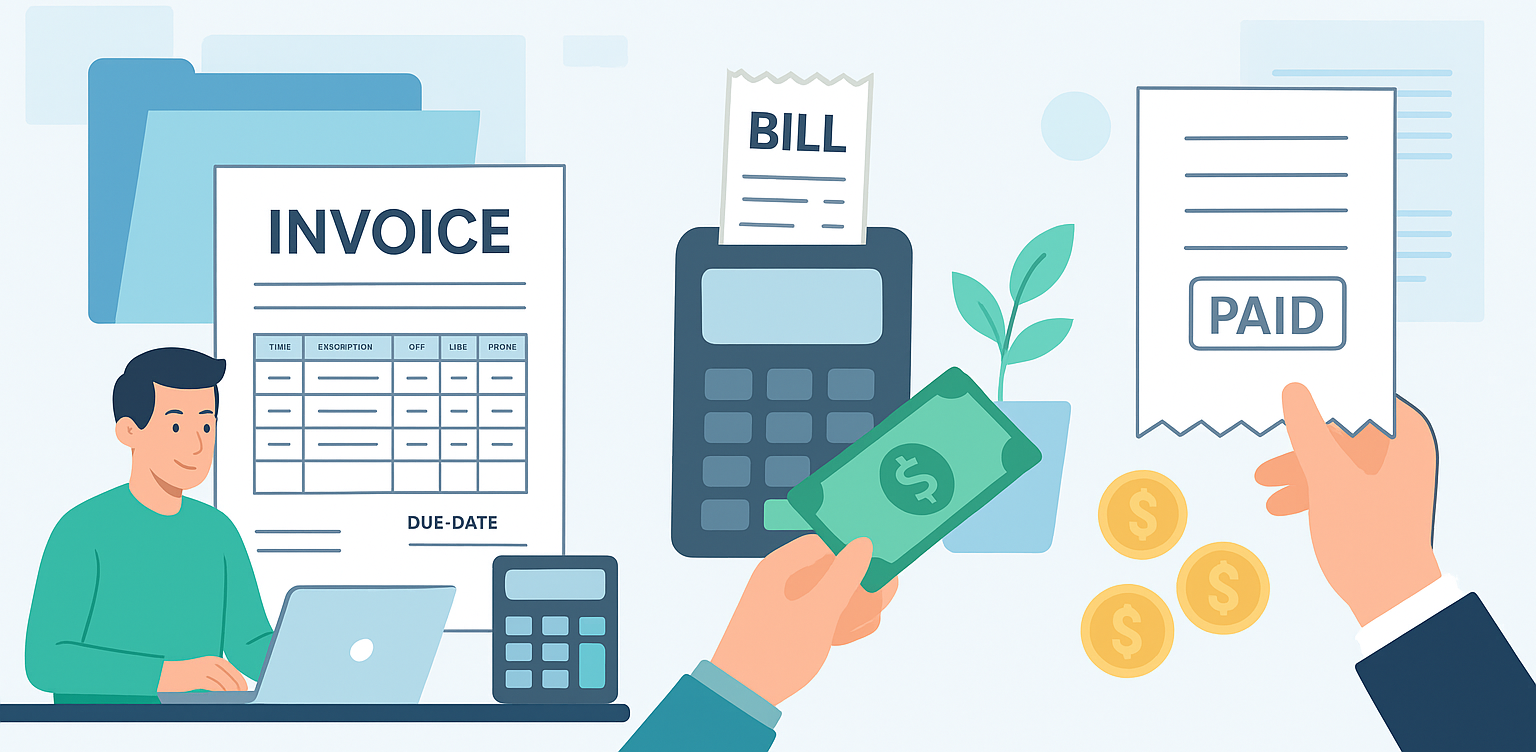
In every commercial transaction, documentation plays a crucial role in defining responsibility, transparency, and legality between buyers and sellers. Whether you’re purchasing groceries, consulting a doctor, or running a trading business — the transaction is recorded using invoices, bills, or receipts.
While these three documents might appear similar, they serve distinct legal and financial purposes. Many businesses — especially small traders and service providers — often use these terms interchangeably, which leads to confusion during audits, taxation, or reconciliation.
This comprehensive guide explores the meaning, features, format, and differences between invoices, bills, and receipts — with real-life examples and a comparison chart — so you can use them correctly in your business operations.
What is an Invoice?
An invoice is a commercial and accounting document issued by a seller to a buyer after goods or services have been supplied. It serves as a formal request for payment and acts as proof of sale.
In a GST-enabled system, invoices are the foundation of tax compliance because they help claim Input Tax Credit (ITC) and record sales and purchases for both parties.
Purpose of an Invoice
- To request payment from a customer.
- To maintain transaction records for accounting and audits.
- To comply with GST and taxation rules.
- To establish the legal ownership of goods or services sold.
When It Is Issued
An invoice is typically issued after supplying the goods or services but before payment is received.
Who Issues It
The seller, supplier, or service provider issues the invoice to the buyer.
Example Scenario
Example:
ABC Electricals supplies 100 ceiling fans to XYZ Traders on credit.
ABC issues an invoice mentioning the quantity, rate per piece, GST applicable, and total value payable within 30 days.
The buyer uses this invoice to make payment and record the purchase in their accounts.
Key Details in an Invoice
A valid invoice under GST or accounting law must include:
- Name, address, and GSTIN of the supplier and buyer
- Invoice number and date
- Description of goods/services supplied
- Quantity and unit price
- HSN/SAC code
- Tax rate (CGST, SGST, IGST)
- Total taxable value and total invoice value
- Payment terms and due date
- Signature or digital authentication

Types of Invoices
- Tax Invoice – Issued for taxable sales.
- Proforma Invoice – Preliminary document sent before sale confirmation.
- Commercial Invoice – Used in international trade.
- Credit Note / Debit Note – Issued to adjust errors or discounts in invoices.
- E-Invoice – Digitally authenticated invoice under GST system.
What is a Bill?
A bill is a document of payment demand that shows what the buyer owes for goods or services purchased, usually meant for immediate settlement. Bills are most common in retail or over-the-counter sales, such as restaurants, grocery stores, or salons.
While invoices are legally structured and required for tax purposes, a bill serves as a simpler version — often used where no credit terms or GST compliance is necessary.
Purpose of a Bill
- To notify the buyer of the amount due for payment.
- To record cash or instant transactions.
- To serve as an informal sales record.
When It Is Issued
A bill is issued at the point of sale or immediately after providing a service.
Who Issues It
Usually issued by retailers, service providers, or merchants.
Example Scenario
Example:
A restaurant provides a food bill after dining, listing each menu item, applicable taxes, and total payable amount. The customer pays before leaving, and the transaction ends.
Key Details in a Bill
- Name of seller
- Date of issue
- Bill number
- Items or services purchased
- Quantity and price
- Total amount payable
- Taxes (if applicable)
- Mode of payment

Types of Bills
- Utility Bill: Electricity, water, gas, or internet bills.
- Restaurant Bill: Food and service charges.
- Medical Bill: Charges for consultation and medicines.
- Retail Bill: Payment for consumer goods.
What is a Receipt?
A receipt is a confirmation document that acknowledges the payment received by the seller from the buyer. It signifies the completion of a financial transaction.
Unlike an invoice or bill, which demands payment, a receipt is issued after payment has been made — making it a proof of payment for both parties.
Purpose of a Receipt
- To confirm that payment has been received.
- To provide proof for accounting, warranty, or refund purposes.
- To serve as evidence in case of disputes or audits.
When It Is Issued
A receipt is issued after payment is received, either in cash, cheque, bank transfer, or digital mode.
Who Issues It
The seller or service provider issues the receipt to the customer.
Example Scenario
Example:
After paying ?5,000 to a tuition center, the student receives a printed receipt acknowledging payment, mentioning date, mode, and amount paid.
Key Details in a Receipt
- Receipt number and date
- Name and address of issuer
- Amount received
- Mode of payment (cash/card/UPI/cheque)
- Purpose of payment
- Signature or digital stamp

Types of Receipts
- Cash Receipt – Proof of cash transaction.
- Bank Receipt – Issued for online or cheque payments.
- Donation Receipt – Used by NGOs for contribution records.
- Official Receipt – Used by government departments or institutions.
Invoice vs Bill vs Receipt – Comparison Table
| Basis | Invoice | Bill | Receipt |
|---|---|---|---|
| Purpose | Requests payment for goods/services | Indicates total amount due for immediate payment | Confirms that payment has been received |
| Stage of Issuance | After sale, before payment | At point of sale | After payment |
| Used In | B2B or large business transactions | B2C or retail transactions | All types of transactions |
| Issuer | Seller or supplier | Retailer or service provider | Seller/service provider |
| Legal Role | Legally binding under GST; allows Input Tax Credit | Not legally binding; used for quick retail sales | Serves as payment proof; used for audits |
| Tax Information | Contains detailed GST/tax structure | May or may not include tax | Usually not included |
| Example | Company selling goods to a distributor | Restaurant bill | Courier payment receipt |
| Accounting Treatment | Recorded as “Accounts Receivable” until paid | Recorded as “Sales” immediately | Recorded as “Payment Received” |
| Document Purpose | Formal sales record | Retail sale record | Proof of settlement |
Key Differences Explained
Legal and Accounting Relevance
- Invoices are legally required under the GST Act for every taxable sale.
- Bills are more informal, used for non-GST or instant transactions.
- Receipts are acknowledgment documents, serving as evidence of payment.
Timing in Transaction Flow
- Invoice – Comes first (after sale).
- Bill – Occurs at the time of sale and payment.
- Receipt – Comes last (after payment is received).
Accounting Entries
- When issuing an invoice:
→ Debit Accounts Receivable / Customer Account
→ Credit Sales Account - When issuing a receipt:
→ Debit Cash/Bank Account
→ Credit Accounts Receivable -
A bill often doesn’t involve credit entries as it’s settled immediately.
GST Implications
- Only invoices are recognized for claiming Input Tax Credit (ITC).
- Bills and receipts are not valid for GST filings unless they qualify as invoices.
Why the Confusion Occurs
People often confuse these terms due to:
- Similar appearance (each lists products, prices, and taxes).
- Casual terminology — retailers often use “bill” instead of “invoice.”
- Digital systems like e-commerce sites that generate “tax invoices” and “payment receipts” simultaneously.
- International usage: In some countries, “bill” and “invoice” are synonymous, adding to the confusion.
Practical Examples
Example 1: Wholesale Business
- Invoice: ABC Steel supplies 10 tons of rods to a builder with 30-day credit.
- Receipt: Issued once payment is received via bank transfer.
(Bill not used here — it’s a credit transaction.)
Example 2: Retail Purchase
- Bill: You buy groceries worth ?2,500 and pay at the counter.
- Receipt: Sometimes combined with the bill itself in retail POS systems.
(No invoice — payment made instantly.)
Example 3: Online Shopping
- Invoice: Sent with shipment details and tax breakdown.
- Receipt: Sent via email once payment is processed.
(The same transaction has both invoice and receipt records.)
Importance in Accounting and Tax Filing
Maintaining invoices, bills, and receipts ensures:
- Transparency between buyer and seller.
- Smooth audits and reconciliations.
- Eligibility for input tax credit under GST.
- Proof of transactions for income tax and legal compliance.
- Ease in refunds, returns, and dispute resolution.
Poor documentation can result in legal penalties, tax disallowances, or loss of customer trust.
Though they are part of the same transaction cycle, each document marks a different stage:
| Stage | Document | Purpose |
|---|---|---|
| Before Payment | Invoice / Bill | Requests or lists payment amount |
| After Payment | Receipt | Confirms payment completion |
In short:
Invoice asks for money, Bill shows what you owe, and Receipt proves you’ve paid.
Using them correctly ensures financial clarity, legal safety, and smooth business operations.
FAQs
Q1. Is an invoice the same as a bill under GST?
No. An invoice is a legally valid GST document. A bill is generally used in cash or non-GST transactions.
Q2. Can a receipt replace an invoice for accounting?
No. A receipt only confirms payment; it doesn’t serve as a tax or sales document.
Q3. Who keeps invoices and receipts?
Sellers keep copies of invoices; buyers keep receipts for proof of payment.
Q4. What happens if an invoice isn’t issued?
Failure to issue invoices can lead to GST penalties and loss of input tax credit.
Q5. Are e-invoices and receipts the same?
No. E-invoices are system-verified tax documents, while receipts simply confirm payment.